
Interfold Community Update: March 2026

March marked a structural transition for the project, as Enclave became The Interfold, a name that captures the core idea behind the protocol: enabling independent parties to coordinate and compute collaboratively while keeping underlying inputs private. The Interfold is a distributed network for confidential coordination. This transition reflects a shift in how the system is described: from a collection of components to a network that enables shared, verifiable outcomes without relying on a single operator.
This transition comes alongside meaningful technical progress. Over the past few weeks, we’ve moved from isolated components toward a more complete, end-to-end system: integrating cryptographic proving into the full execution flow, and laying the groundwork for external testnet participation.
Technical Progress & R&D
Over the past few weeks, the team has been focused on advancing the core protocol architecture and preparing Interfold for broader testing. Work has centered on enabling end-to-end execution under encryption, including circuit design, proof aggregation, and integration into the execution flow, and strengthening the developer and testing infrastructure.
Execution & Proving
A major milestone was reached in the design and early implementation of recursive proof aggregation. The PV-TRBFV protocol requires multiple circuit proofs across different phases. Recursive aggregation allows these proofs to be combined efficiently, reducing on-chain verification to a constant-size proof, regardless of the number of parties or protocol steps.
In parallel, we successfully integrated proof generation into the end-to-end execution flow, marking an important step toward a fully functional proving pipeline. With this integration now working internally, the next milestone is enabling on-chain proof verification once aggregation is finalized.
Circuit Optimization
We also made meaningful improvements to the efficiency of our proving system. Several circuits were refactored into smaller, modular components connected via cryptographic commitments.
This restructuring brings two main benefits:
- Parallelized proving, allowing different circuits to be processed simultaneously
- Reduced memory requirements for ciphernodes, making participation more accessible
While these changes introduce a small coordination overhead, the gains in performance and resource efficiency make the tradeoff worthwhile for the network.
Network Enforcement (Ciphernodes)
A significant new capability has been added to the protocol: an end-to-end fault attribution and slashing system for ciphernodes, implemented across both the Solidity smart contracts and the Rust ciphernode stack.
The system allows committee members to automatically detect and reach consensus on faulty behavior, such as submitting invalid proofs, through an off-chain voting protocol. Once quorum is reached, the fault is enforced on-chain: the misbehaving node's bond is slashed, they can be banned and expelled from the committee, and if enough members are removed, the execution is automatically marked as failed.
A companion refund mechanism ensures fair economic outcomes: requesters are refunded proportionally for uncompleted work, honest nodes are compensated, and slashed funds are redistributed as additional rewards.
The system supports both proof-based and governance-initiated slashing, with an appeal window for disputed cases.
Documentation & Research
To support transparency and external review, the team has begun documenting the architecture in depth. We have:
- Published internal documentation for the circuits and proving flow
- Started drafting a technical paper describing the protocol design
- Begun preparing a blog post to explain the architecture and design choices to the broader community
These materials will help external contributors, researchers, and node operators better understand how the system works.
Testnet Preparation
We are also approaching an important operational milestone: launching a testnet with external nodes. This will allow the protocol to move beyond internal testing and begin validating the system under distributed operator participation.
The testnet will focus on:
- running ciphernodes in distributed execution conditions
- validating the end-to-end proving and execution flow
- stress-testing protocol components under distributed operation
Infrastructure Improvements
Alongside core protocol work, we made several smaller improvements to the development environment:
- Expanded CI coverage and improved test reliability
- Strengthened internal tooling and workflows
- Continued incremental refactors to support the evolving architecture
This work brings us to the final milestone of Phase 2, with only one major task remaining before we transition into Phase 3 and move ahead with the upcoming testnet launch.
Network & Ecosystem
We’re currently working with the team behind Session - the end-to-end encrypted messenger designed to protect user privacy and eliminate metadata collection, to explore how confidential analytics can produce system-level insights without exposing individual data.
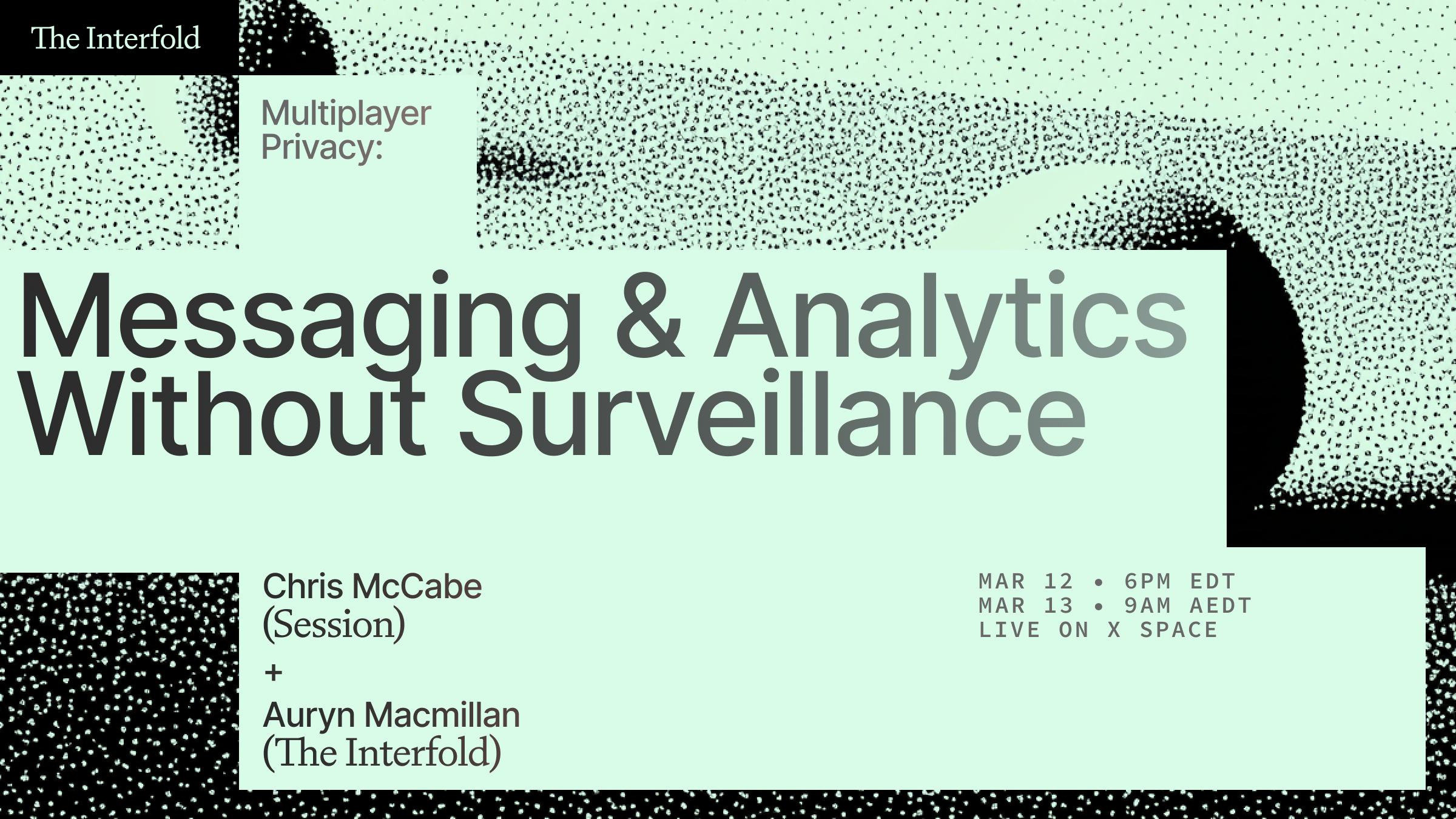
Last week, we hosted Chris McCabe, the founder of Session, in our X Space series Multiplayer Privacy. Interfold founder Auryn Macmillan and Chris discussed how messaging and analytics can coexist without surveillance, and what the next generation of privacy-preserving infrastructure could look like.
🎧 Listen to the full Space recording here.
Follow the Interfold on X to keep up to date with upcoming Multiplayer Privacy conversations.
Quick Links
Docs: https://docs.theinterfold.com/introduction
GitHub: https://github.com/gnosisguild/enclave
Blog: https://blog.theinterfold.com
Discord: https://discord.gnosisguild.org
Telegram: https://t.me/enclave_e3