
What is Network Alpha?
The Interfold’s first coordinated network phase, bringing E3 execution, ciphernodes, and early integrations into real operating conditions.
Network Alpha is the first coordinated phase of the Interfold network: a staged rollout that moves the system from internal protocol development toward real network operation.
This phase brings together ciphernodes, early integrations, E3 execution flows, and production validation under controlled conditions. It is not the final open network. It is not the FOLD auction. It is not TGE.
Network Alpha is the first step toward making confidential coordination usable in real digital systems: votes, auctions, shared analytics, and other processes where private inputs need to produce verifiable outcomes. It exists to validate the Interfold’s core operating model under controlled conditions.
 gnosis guild
Why Network Alpha exists
The Interfold is a distributed network for confidential coordination. It lets companies, institutions, and communities compute together, even in competitive or adversarial settings: each party keeps its inputs private, while everyone can verify the result is correct.
That kind of system cannot be launched as a single switch-flip event. Confidential coordination depends on encrypted inputs, execution within E3s (Encrypted Execution Environments), ciphernode coordination, threshold decryption, verification, lifecycle management, and operational support all working together under real conditions.
Network Alpha gives the system a path to validate those processes, assess operational reliability, and identify issues under controlled real-world conditions.
What is being tested
Network Alpha focuses on the core flows that make confidential coordination possible.
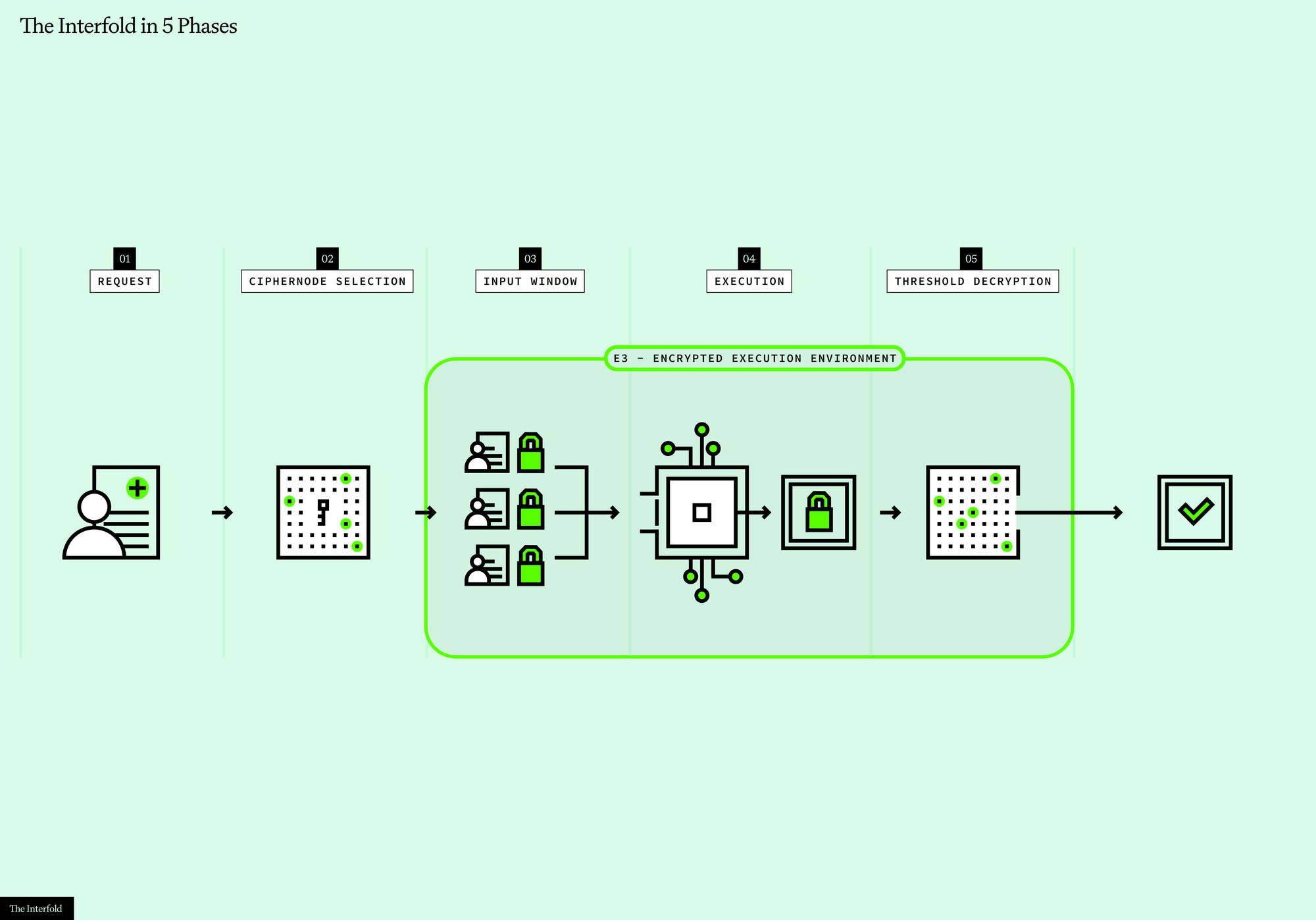
This includes the full E3 lifecycle: requesting an execution, forming the relevant ciphernode committee, accepting encrypted inputs, executing defined program logic, verifying the computation, coordinating threshold decryption, releasing the outcome, and closing the execution surface.
It also includes the operational layer around the network: onboarding selected ciphernode operators, monitoring reliability and uptime, understanding operator drop-out rates after committee selection, measuring real network latency, testing support processes, supporting early integrations, improving tooling, and refining documentation.
The goal is not to prove cryptography in isolation. The goal is to confirm that the network can coordinate encrypted execution across operators, applications, and users.
Why the rollout is staged
Network Alpha is designed as a staged rollout. The network is designed for permissionless participation, but early operation requires close coordination with node operators as the system is monitored under real conditions.
The Interfold distributes execution authority across a network. That network needs reliable operators, clear procedures, tested lifecycle flows, and enough operational visibility to diagnose issues as the system moves toward broader use.
A staged rollout allows the team to test performance, reliability, security assumptions, operator costs, and support processes as the network matures. Network Alpha should be understood as early network operation, not the final state of the network.
How Network Alpha relates to ciphernodes
Ciphernodes are the operator layer of the Interfold network.
For each computation, a committee is formed from the operator set to participate in setup, execution coordination, and threshold decryption for the relevant E3. No single ciphernode can expose private inputs, control decryption, alter execution logic, or determine outcomes unilaterally.
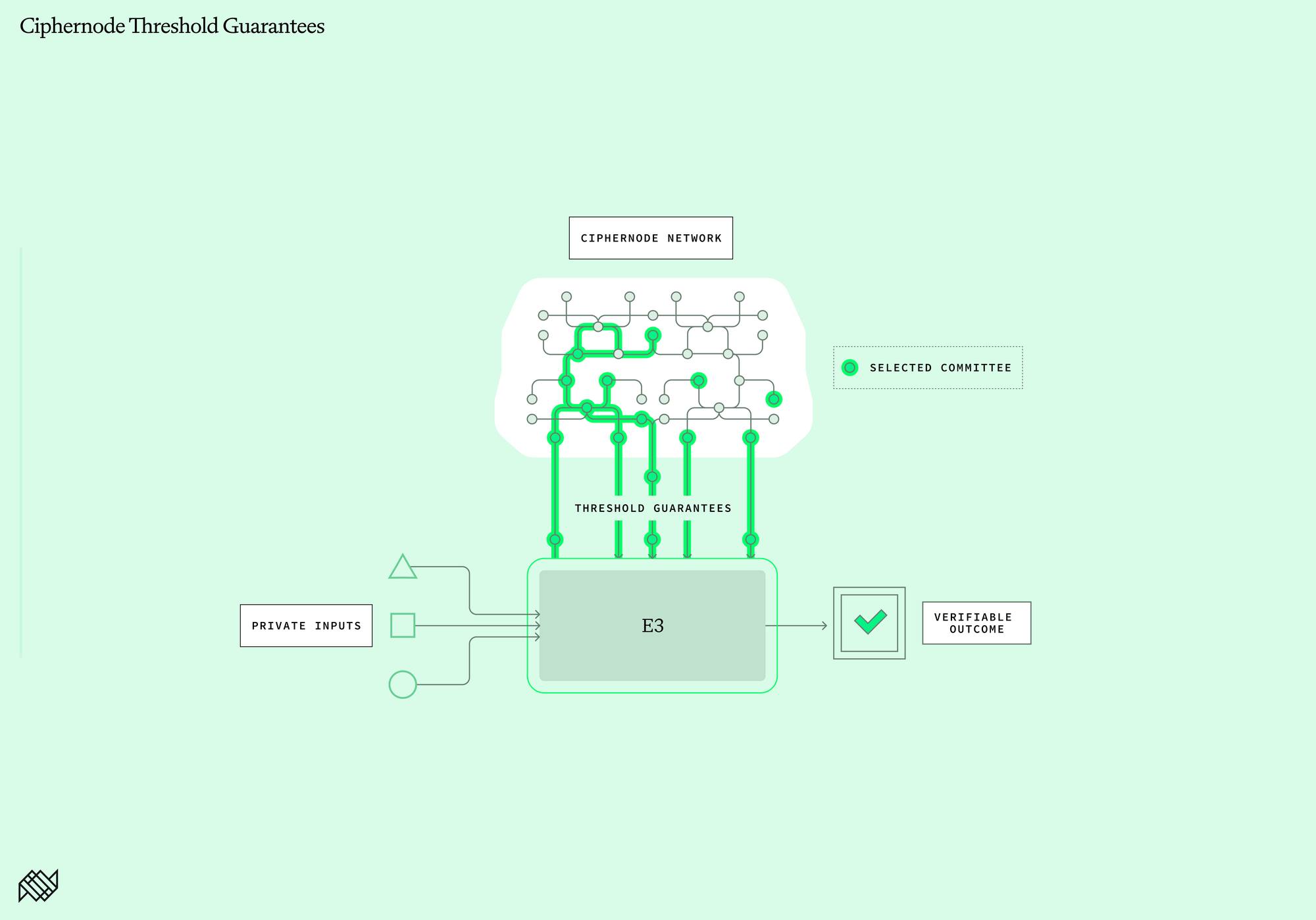
During Network Alpha, ciphernodes help validate the network’s operating model. The purpose is practical: confirm that operator coordination, threshold processes, and network rules work reliably under real conditions.
How Network Alpha relates to FOLD
FOLD is part of the broader Interfold launch sequence, but the FOLD auction is not Network Alpha.
The auction is a token distribution event. TGE marks the start of token transferability. Network Alpha is the staged rollout of the network itself.
Each phase has separate timing, constraints, and purpose.
 gnosis guild
What comes next
Network Alpha is a coordinated phase of early network operation. Additional details on participation and network usage will be shared through official Interfold channels as they are finalized.
Follow the Interfold: Track the network as it evolves, with updates, early use cases, and the emergence of a distributed system in practice.
Build on Interfold: Create applications that coordinate across private inputs and produce verifiable outcomes.
Interested in running a ciphernode?
Review the current operator requirements and prepare for participation.
Important Information
The FOLD auction, general FOLD transferability, and Network Alpha are distinct parts of the launch sequence.
Official information will be published only through Interfold’s verified channels.
Eligibility notice. Participation in the FOLD auction is subject to eligibility requirements, jurisdictional restrictions, verification procedures, AML/sanctions screening, and other applicable restrictions. Participation may be restricted in certain jurisdictions.
Issuer notice. The FOLD auction will be conducted by Interfold Ltd. (the “Issuer”). Participation in the FOLD auction will be subject to the official Auction Terms, eligibility requirements, and verification procedures.
No advice / risk notice. Nothing in this communication constitutes legal, tax, financial, investment, or other professional advice. The auction floor does not represent any projection, estimate, or guarantee of FOLD’s actual price or value.
Read the full FOLD Auction Terms.