
Interfold Governance is Live
Interfold governance is live, giving FOLD holders a way to make private, verifiable decisions about how the network develops.
Interfold governance is now live.
FOLD holders can activate voting power, participate in proposals, and take part in decisions about how the Interfold network develops.
The first governance process is already underway, with the community voting on ratification of the Interfold Constitution. It is the first live use of Interfold’s secret-ballot governance process to the network’s own decision-making.
Interfold governance is built on Aragon OSx, with receipt-free secret-ballot voting for Interfold Protocol Proposals (IPPs).
Participate in governance
Lock and delegate FOLD ahead of upcoming proposals.
Put FOLD to work
Governance power comes from committed FOLD, not simply from holding FOLD in a wallet. Locked and delegated FOLD, bonded FOLD, and eligible vesting FOLD all contribute voting power at the same rate:
1 FOLD = 1 vote.
Participants with at least 12K FOLD of active voting power can create proposals. Any non-Foundation holder with active committed FOLD voting power is eligible to vote.
Voting power is snapshotted when a proposal is created. If you want wallet-held FOLD to count in an upcoming vote, it must be locked and delegated before that proposal goes live.
The governance documentation covers the full voting-power model, current parameters, and proposal lifecycle.
The first governance process
The first governance process is the ratification of the Interfold Constitution, which sets out the DAO's governing principles, processes, and relationship with the Interfold Foundation.
This gives the community an opportunity to use Interfold governance itself before the first major Network Alpha proposal.
Next comes Genesis Ciphernodes, a proposal concerning an initial program to support ciphernode operators during this stage of Network Alpha.
If you want to participate in Genesis or other upcoming proposals, activate your voting power before the proposal is created.
Secret ballots are the default
When governance is making decisions about the network, how those decisions are reached matters alongside the outcome itself.
A receipt-free secret ballot lets people make choices privately while still producing a publicly verifiable result.
 gnosis guild
 gnosis guild
How secret-ballot voting works
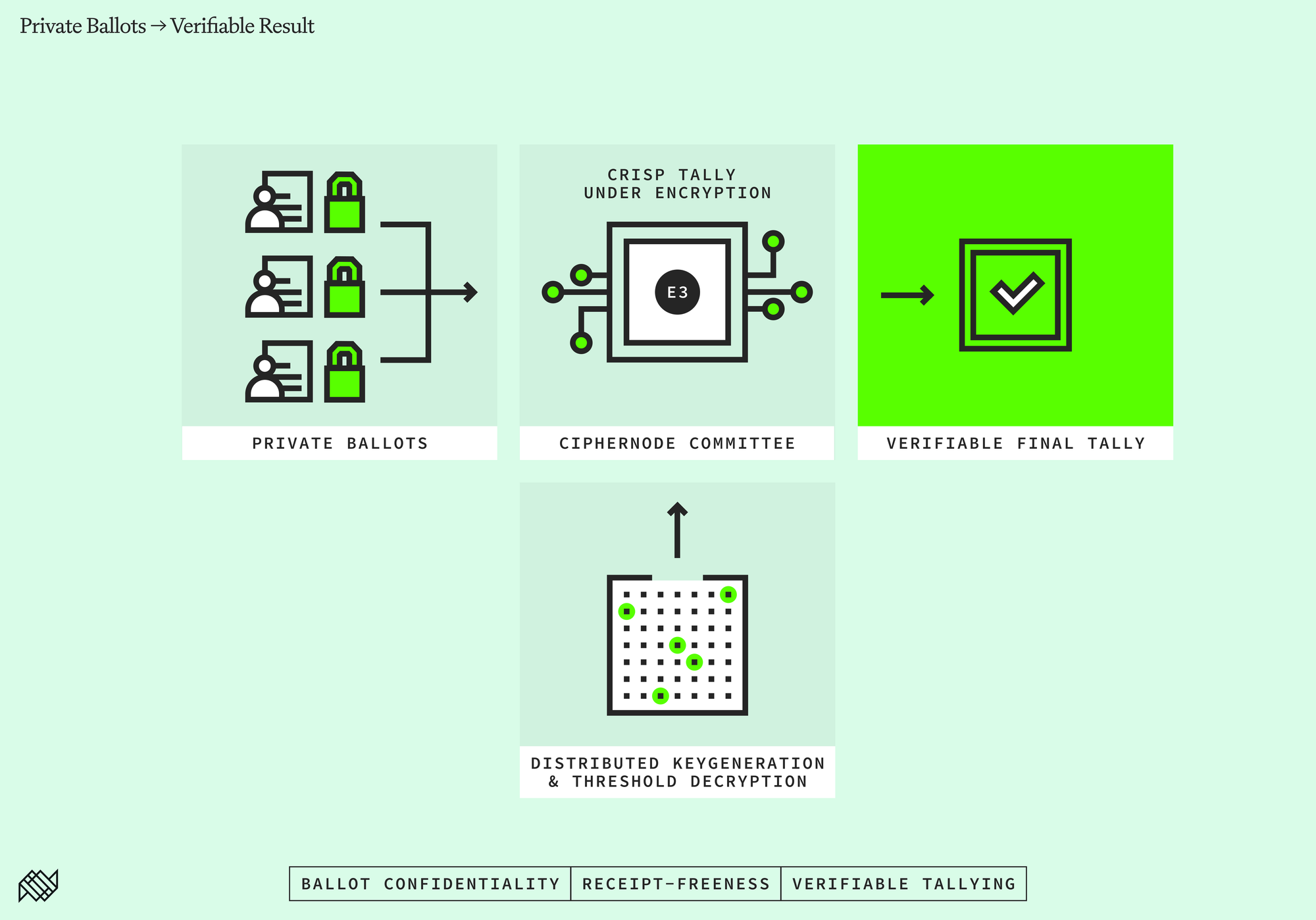
Interfold’s secret-ballot voting is implemented through CRISP, a reference implementation built on Interfold and integrated with Aragon OSx for governance.
Ballot confidentiality
Individual votes remain private throughout the voting process.
Ballots are encrypted before submission and tallied under encryption within an Encrypted Execution Environment (E3). The permitted output is the aggregate result, not the underlying individual ballots.
Receipt-freeness
A private ballot is not enough if a voter can later prove how they voted.
The system is designed so observable ballot activity cannot serve as a reliable receipt. Its masking mechanism makes genuine vote updates computationally indistinguishable from decoy updates, so an outside observer cannot reliably determine whether visible activity reflects a voter’s true or final choice.
That makes coercion, vote buying, and similar forms of pressure harder to enforce. Read: Vote Masking and the Problem of Receipt-Freeness →
Verifiable tallying without a trusted tallier
Privacy should not require handing control of the tally to one operator.
For each secret-ballot round, a ciphernode committee participates in distributed key generation and threshold decryption. No single ciphernode holds complete decryption capability, and only the permitted result is decrypted.
The tally can be verified while individual ballots remain private, with decryption requiring threshold participation from the selected ciphernode committee. Read: Verifiability in the Coordination Trilemma →
From proposal to execution
The current governance lifecycle is:
- Proposal
- Community vote
- Foundation approval
- Execution
Proposals that pass the community vote move to Foundation Approval, where the Foundation Board reviews them before implementation in accordance with the Foundation’s governing requirements.
The Interfold Constitution, currently being put to the community for ratification, sets out the DAO’s governing principles, processes, and relationship with the Interfold Foundation, including the broader framework for proposals, voting, Foundation approval, and execution.
The governance documentation explains the governance lifecycle and the respective roles of the DAO and Foundation in more detail.
Governance also includes a fallback path for resilience. If the secret-ballot voting path is unavailable or experiencing an issue, governance can fall back to a Fallback Interfold Protocol Proposal (FIPP) using transparent onchain voting. The same FOLD voting-power model applies, but individual votes and tallies are public. FIPP is a resilience mechanism, not an alternative default voting mode.
Governance as confidential coordination
Voting is one of the clearest examples of confidential coordination.
A useful secret ballot has to preserve both sides of the process: people should be able to make choices privately, and the group should still be able to trust the result. Public ballots give up the first. A trusted tallier weakens the second.
Interfold is designed to let private inputs contribute to a shared result without exposing those inputs or putting control of the outcome in one place.
With FOLD governance live, Interfold is applying that model to itself.
The network is now using confidential coordination as part of how its own decisions are made:
private choices → encrypted aggregation → shared, verifiable decision
Governance is not simply another application of Interfold. It is one of the clearest places to apply what the network was built to do.
Participate in governance
Explore the dashboard and activate your voting power.