
The Network Is Forming
Network Alpha is where Interfold moves from deployment into operation: operators come online, governance activates, production E3s run, and applications begin creating demand for the network.
Interfold is live on mainnet. Network Alpha is the period in which that deployment develops into an operating network: independent operators come online, FOLD is committed to network roles, governance becomes active, and production Encrypted Execution Environments (E3s) begin running regularly.
The Interfold lets companies, institutions, communities, or complete strangers compute together on sensitive data: each party keeps its inputs private, while everyone can verify the shared result.
For that capability to support broader use, the network itself has to deepen: the operator set has to expand, governance has to become active, and applications have to begin requesting E3s.
Ciphernodes are joining the network
Operators are already joining the network and bonding FOLD to participate. Growing that independent operator set is one of the immediate tasks of Network Alpha.
When a confidential computation is requested, a committee is selected from the operator set to coordinate duties including distributed key generation and threshold decryption. No single ciphernode holds the full decryption key, and multiple operators are required to complete the process.
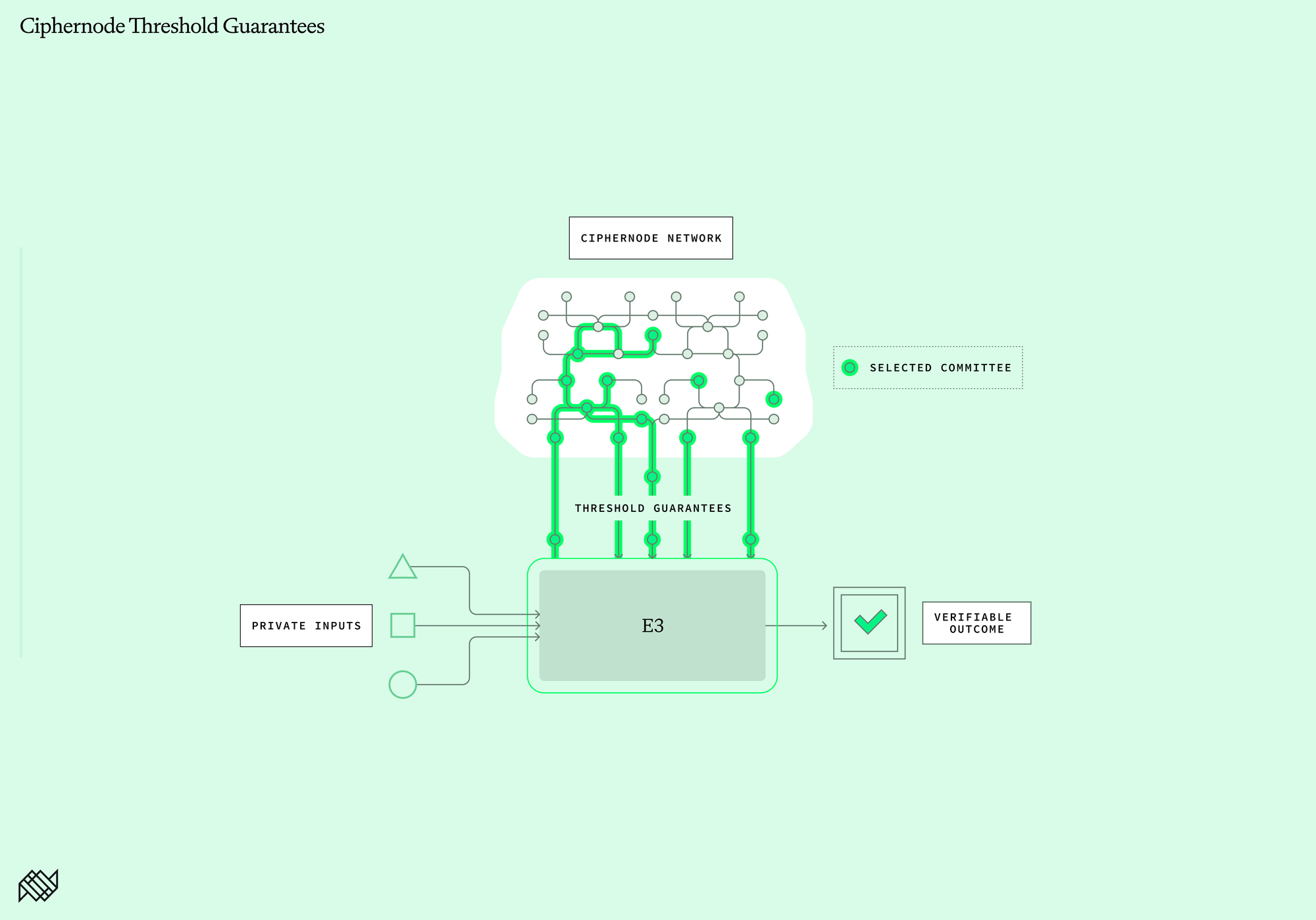
Bonding FOLD makes operators economically accountable for those duties. They run the ciphernode software and participate in E3 committees when selected.
As the operator set grows, more independent participants are available to perform committee duties as E3 activity develops.
Join the operator network
Bond FOLD and run a ciphernode to participate in network operations.
Governance comes next
Governance is not live yet, but holders can already prepare their voting power ahead of the first proposals.
Bonded and delegated FOLD serve different purposes. Bonding supports ciphernode participation. Locking and delegation activate governance voting power.
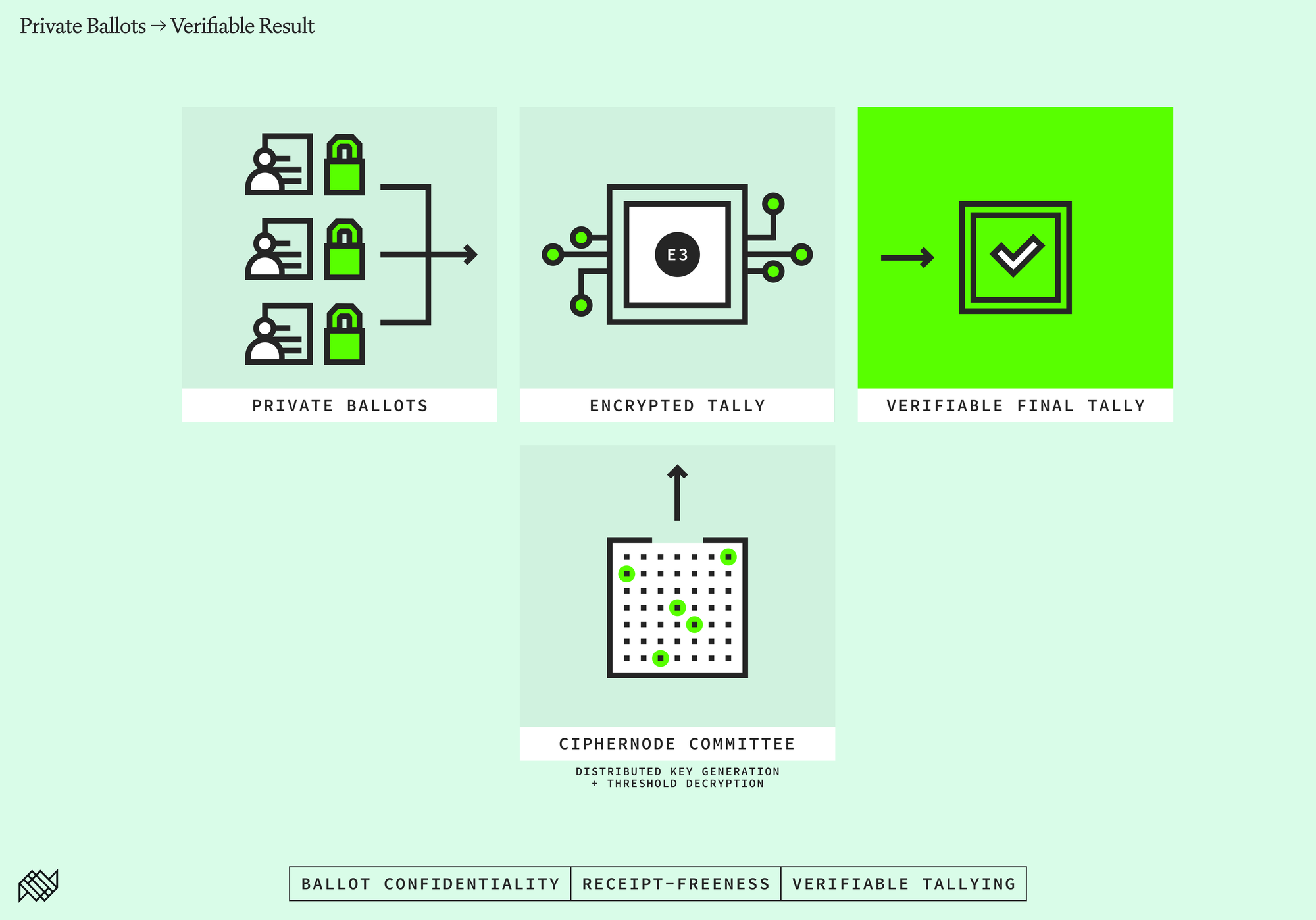
Interfold governance is built on Aragon OSx. Its secret-ballot path uses CRISP, Interfold’s receipt-free voting implementation, running on Interfold itself. Ballots are encrypted client-side and tallied under encryption in an E3; individual votes remain private while the final result can be verified.
The first governance proposal will therefore also be one of the network’s first production applications: Interfold being used to govern Interfold.
Participate in governance
Lock and delegate FOLD ahead of upcoming proposals.
Hardening production E3 execution
The next operational proof point is repeated production E3 execution across a growing operator set.
Each E3 is ephemeral and created for a specific confidential computation. Its lifecycle coordinates committee selection, threshold key generation, encrypted inputs, computation and verification, and finally threshold decryption.
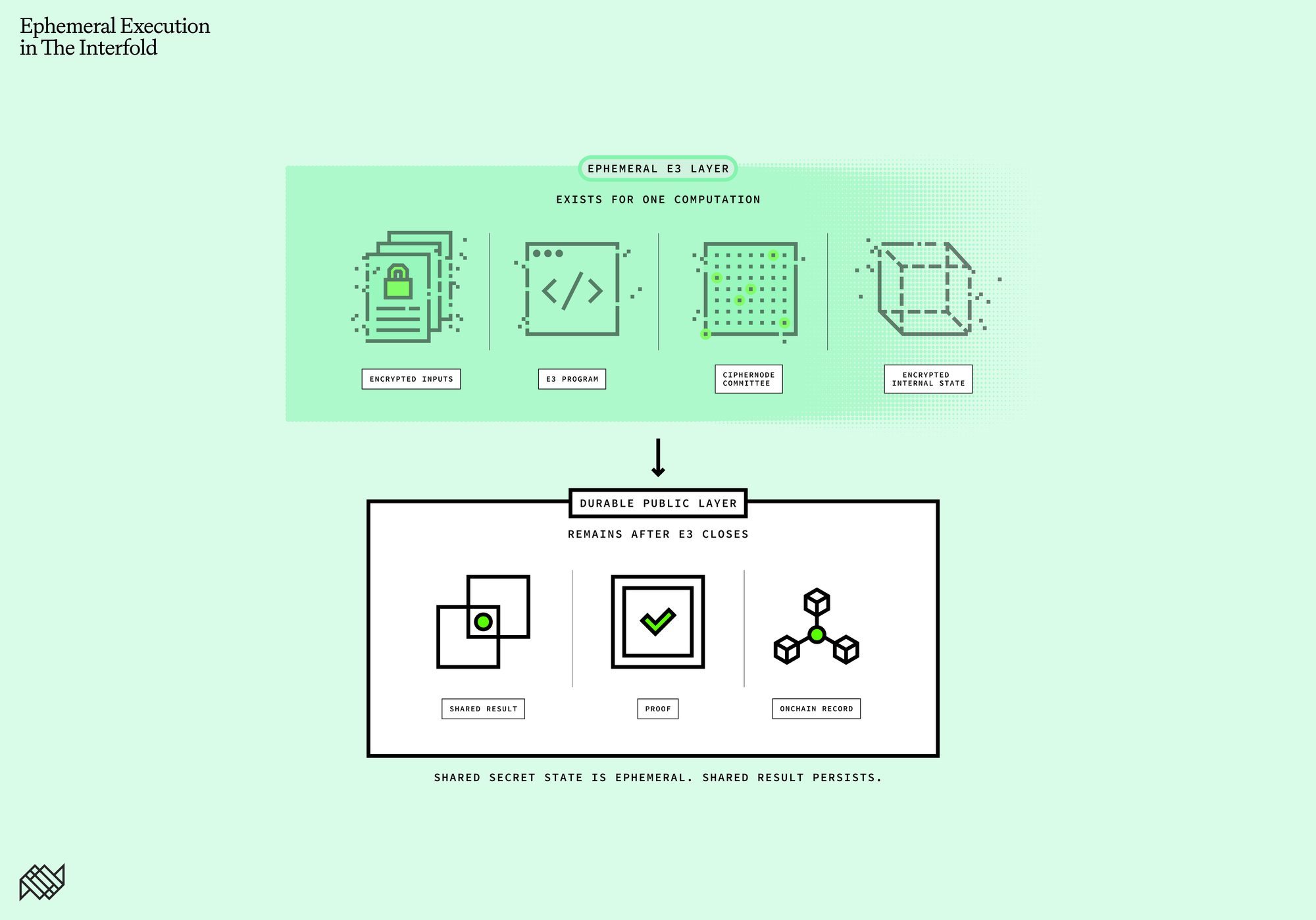
Production adds practical constraints around security, data availability, cost, monitoring, upgrades, and operator performance. The current work is focused on hardening that lifecycle under mainnet conditions.
We’ll cover the engineering work in more detail in a separate update.
Beyond governance: auctions and other applications
The operator network makes E3 execution possible. Applications turn that capability into use.
Governance is one early application. Sealed-bid auctions are another important one.
Auctions are a core market mechanism across DeFi, used for liquidations, token distribution, solver competitions, allocation, and other forms of price discovery and coordination. But sealed-bid designs are difficult to implement on transparent infrastructure without exposing bids and strategies or reintroducing a trusted auctioneer.
 gnosis guild
With Interfold, bids can remain encrypted through the computation, with the permitted result verified and threshold-decrypted at the end.
Beyond auctions, the same model can support coordination across sensitive data. Institutions may want to derive shared metrics without pooling proprietary datasets. Organizations may need to compute across confidential information while revealing only a defined result. AI systems and agents may need to work across inputs that cannot be exposed to every participant in a shared process.
Across these applications, the pattern is the same:
private inputs → shared, verifiable outcomes
This is how application demand becomes network activity. E3 requests create committee duties, repeated execution, and more use of the infrastructure by independent participants.
What comes next
More than 512K FOLD is currently bonded across ciphernodes, while approximately 4.53M FOLD has been delegated toward governance. FOLD is already being committed to two distinct network roles as Network Alpha develops.
From here, the markers are increasingly operational: a larger independent operator set, governance live, repeated production E3s, additional coordination schemes and integrations, and more activity initiated by users beyond the teams building the protocol.
Those are the next signs of network formation we’ll be watching: more independent operators, governance in use, E3s becoming routine, and applications generating activity of their own. As more of that activity comes from participants beyond the teams building the protocol, Interfold becomes increasingly independent in operation.
Join the operator network
Bond FOLD and run a ciphernode to participate in network operations.
Participate in governance
Lock and delegate FOLD ahead of upcoming proposals.
Build on Interfold
Create applications for confidential coordination.