
What are ciphernodes?
Ciphernodes are the Interfold’s distributed operator layer, participating in distributed key generation and threshold decryption for E3s without concentrating execution authority in a single operator.
The Interfold is a distributed network for confidential coordination: the ability for multiple independent parties to produce shared outcomes from private inputs without pooling data or delegating decryption authority to a single operator.
Ciphernodes are the operators that make this possible.
Their network role is to participate in distributed key generation (DKG) and threshold decryption. For each computation, ciphernodes help produce the public key used to encrypt inputs, then contribute decryption shares once the approved output is ready.
Join the operator network
Bond FOLD and run a ciphernode to participate in network operations.
To learn what ciphernodes do and how permissionless operator participation will work, keep reading.
Why ciphernodes matter
Encrypted inputs are not enough.
A system can keep data encrypted and still concentrate authority around whoever controls setup, execution, completion, or decryption. In that model, privacy depends on a trusted operator.
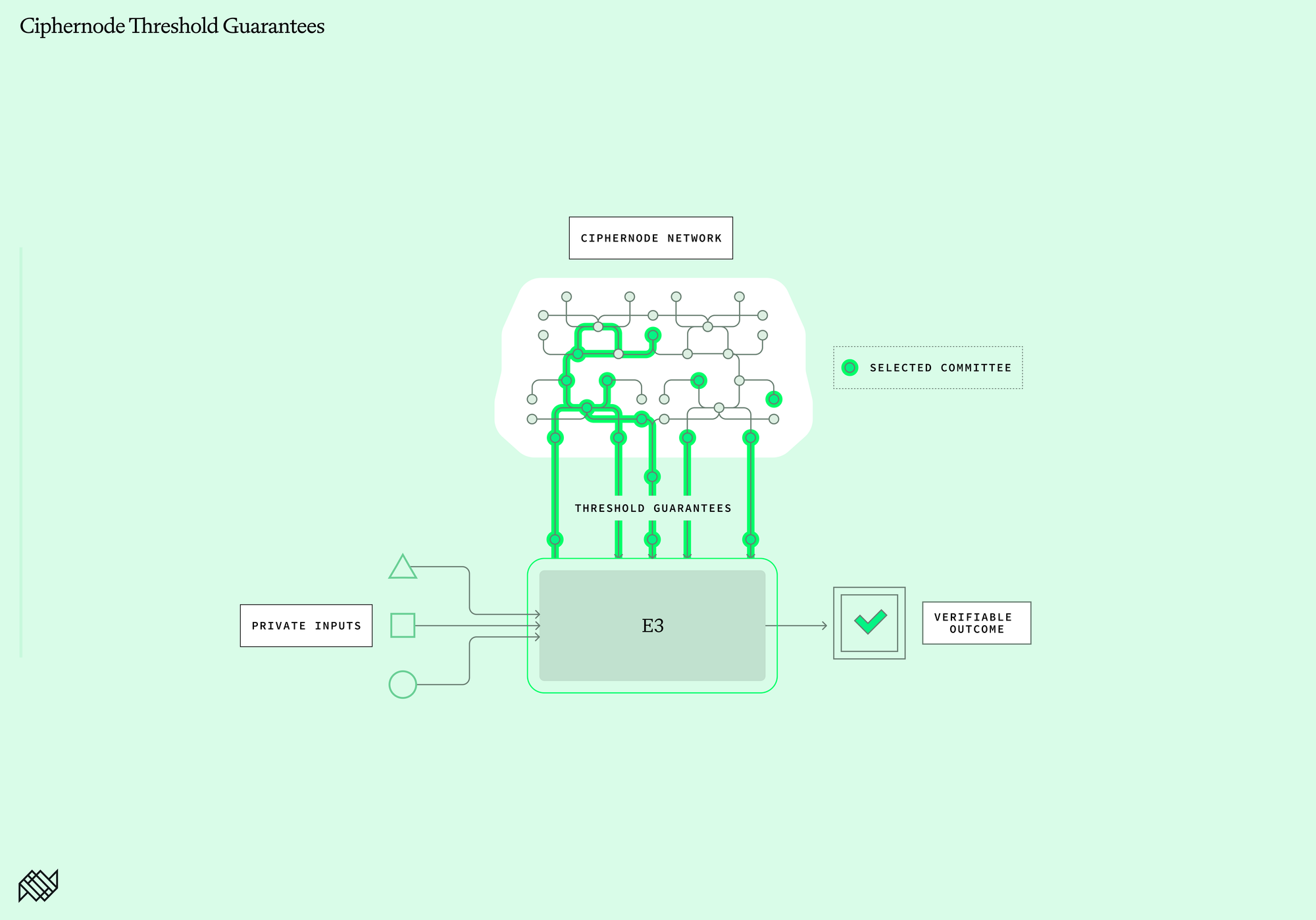
Confidential coordination requires something stronger: threshold guarantees that ensure no single party can expose inputs, control decryption, or unilaterally control the process.
That is why the Interfold needs ciphernodes.
A ciphernode’s role is not to access private data. Its role is to participate in the threshold processes that prevent any single operator from exposing inputs or decrypting approved outputs alone.
What ciphernodes do
Ciphernodes participate in the network processes that make confidential coordination possible.
In practice, when selected to a committee for an Encrypted Execution Environment (E3), ciphernodes perform threshold cryptographic duties. Their core duties include:
- participating in distributed key generation (DKG)
- participating in threshold-governed enforcement during the E3 lifecycle
- contributing decryption shares for permitted E3 outputs
They do not act as custodians. They do not hold raw data. They do not independently determine results.
Their role is to participate in distributed key generation and threshold decryption, so no single operator holds full decryption authority.
From network to committee
Ciphernodes do not act as one undifferentiated network for every computation.
For each E3, the protocol uses sortition — randomized committee selection — to form a bounded committee from the broader ciphernode network.
An E3 is an ephemeral execution surface created for a specific computation. It receives encrypted inputs, runs defined program logic under threshold-governed conditions, supports verification, and closes once the E3 program output is decrypted.
That committee handles the threshold cryptographic duties for the computation, including key generation and threshold decryption of permitted outputs.
This distinction matters: the full ciphernode network is the operator layer of the Interfold, but each computation depends on threshold duties carried out by a specific committee selected under protocol rules.
In order to keep confidential coordination from depending on a single runtime, decrypton authority is distributed across a selected committee rather than assigned to one operator.
Why execution needs its own operator layer
Most blockchain systems already have operators. Validators maintain state. Sequencers determine ordering.
Ciphernodes participate in a different part of the system: the operator layer that provides threshold guarantees for confidential coordination.
Most networks distribute validation, but few distribute decryption authority.
For confidential coordination, that difference is the point. Private inputs and verifiable outcomes are not enough if execution is still governed by one operator.
Without this operator layer, encrypted execution risks becoming another hosted service. Private inputs may remain encrypted, but authority over setup, completion, and decryption still concentrates around whoever controls the environment.
What ciphernodes make possible
Ciphernodes support systems where multiple parties contribute private inputs to produce a shared, verifiable result.
These systems tend to fall into three coordination types:
- Competitive coordination: sealed-bid auctions, confidential pricing, allocation systems
- Collective coordination: secret ballots, impartial selection, governance voting
- Data coordination: model evaluation, shared metrics, cross-institutional analysis
At the end of an auction, the winning bid can be revealed without turning every losing bid into market intelligence. At the close of a vote, a result can be verified without creating a public record of individual pressure points. At the completion of a shared analysis, institutions can rely on a result without turning collaboration into data custody.
The point is not that ciphernodes create these applications by themselves. The point is that they provide the distributed threshold guarantees those applications need.
Running a ciphernode
The Interfold is now operating in Network Alpha, its first production mainnet phase.
Ciphernode participation is now open to operators who meet the protocol’s technical, bonding, and ticket requirements. Operators run the required software, bond FOLD, maintain the required sortition tickets, and register onchain to participate in the operator network.
Ciphernode operation is an economically accountable role, with protocol-defined incentives for correct participation and penalties for provable misbehavior or failure to perform required duties.
Join the operator network
Bond FOLD and run a ciphernode to participate in network operations.