
Understanding the FOLD Token
How FOLD supports operator bonding, E3 request economics, rewards, and governance across the Interfold network.
FOLD is the token that supports participation, coordination, and governance within the Interfold network.
The Interfold is a distributed network for confidential coordination. It lets companies, institutions, and communities compute together, even in competitive or adversarial settings: each party keeps its inputs private, while everyone can verify the result is correct.
Within that network, FOLD supports operator bonding, E3 request economics, operator rewards, and governance. (For supply and distribution details, see FOLD tokenomics.)
 gnosis guild
Why the network needs FOLD
The Interfold coordinates threshold decryption across a network of ciphernodes, so no single operator controls output decryption.
For each computation, ciphernodes participate in a distributed key generation ceremony, execution coordination, and threshold decryption for the relevant E3 (Encrypted Execution Environment). This structure ensures that no single operator can expose private inputs, control decryption, alter execution logic, or determine outcomes unilaterally.
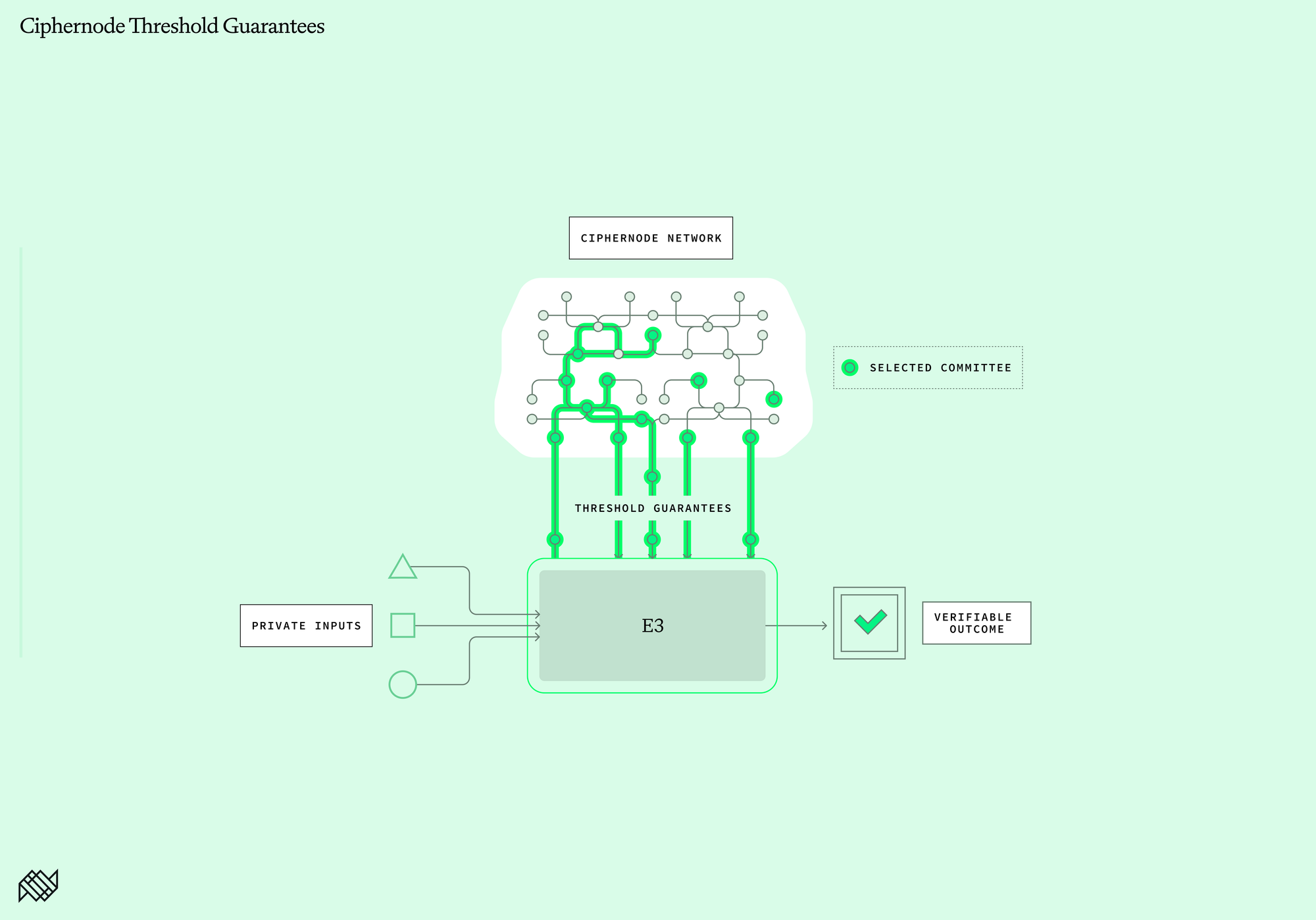
To make this operator set reliable, participation needs economic accountability. FOLD provides the basis for that accountability.
Rather than relying on a trusted intermediary to manage execution, the Interfold uses protocol rules, threshold cryptography, and economic commitments to coordinate participation across independent operators.
1. Operator bonding
Ciphernodes participate in the network by bonding FOLD, along with a stablecoin.
Bonding is the mechanism by which operator participation becomes economically accountable, creating an economic commitment to correct network participation. Operators that perform their duties can be eligible for rewards. Operators that violate protocol rules or fail to perform required duties may be subject to penalties according to network rules.
The purpose of bonding is not passive yield. It is network security. FOLD is used to support an accountable operator set for confidential coordination.
2. E3 request economics
E3s, or Encrypted Execution Environments, are ephemeral execution surfaces coordinated by the Interfold network.
When an E3 is requested, network resources are required: a ciphernode committee must be formed, threshold processes must be coordinated, encrypted inputs must be handled, computation must be verified, and outcomes must be made available through threshold decryption under defined conditions.
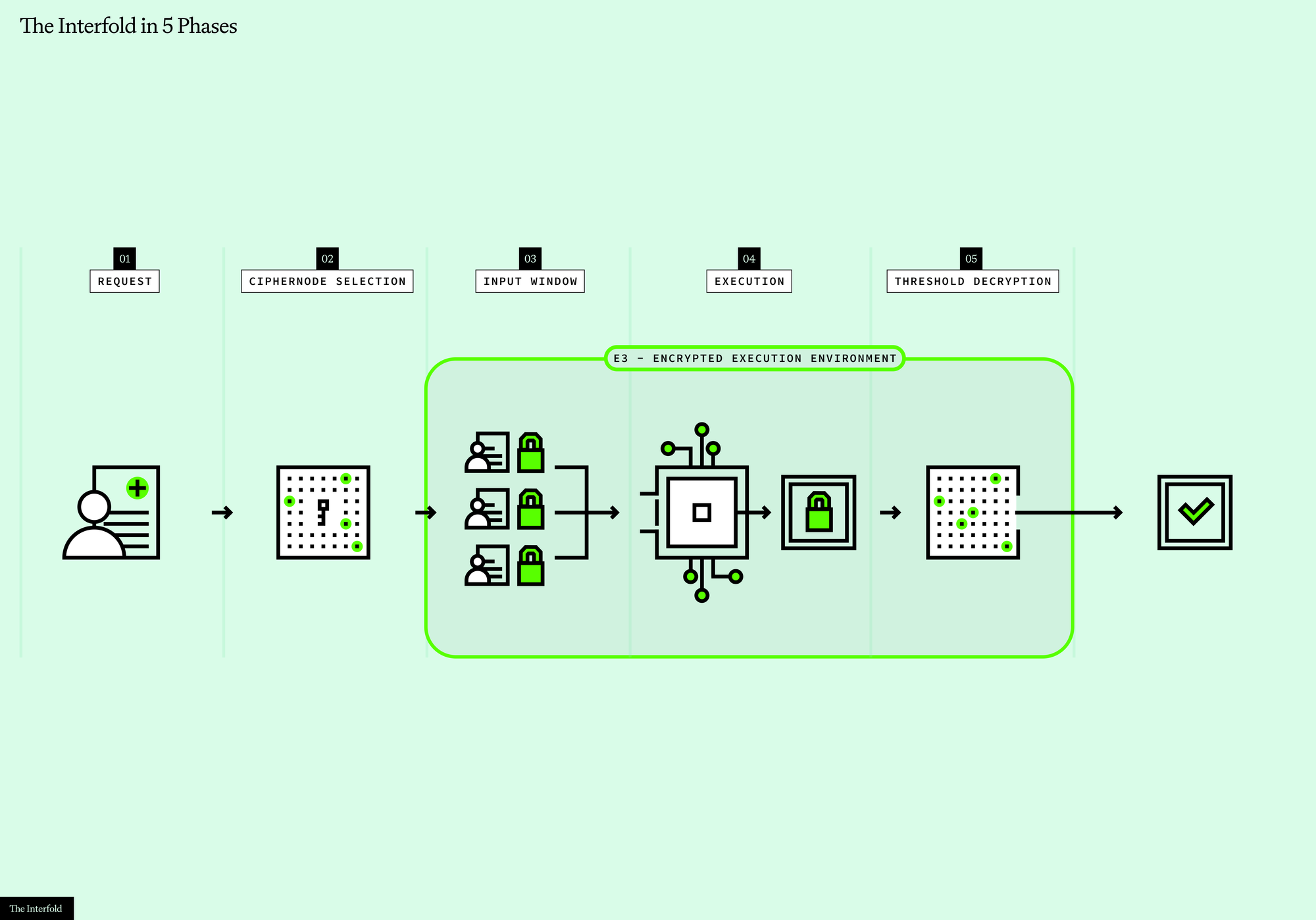
FOLD provides the economic layer for these requests, helping coordinate the operators and protocol processes that support confidential coordination.
3. Operator rewards
Ciphernodes perform active network duties. They participate in threshold coordination, support E3 lifecycle execution, contribute to threshold decryption, and help enforce protocol rules.
In return, operators may receive rewards for correct participation.
These rewards are tied to active contribution to network operation. The role of a ciphernode is not to hold a token passively, but to help enforce confidential coordination under protocol-defined conditions.
 gnosis guild
4. Governance
FOLD also supports governance of the Interfold network.
Governance is responsible for decisions that affect the protocol and its long-term operation. These may include network parameters, operator requirements, protocol upgrades, treasury decisions, and other system-level responsibilities.
Because the Interfold coordinates confidential execution across independent parties, governance must remain aligned with the network’s core purpose: preserving confidentiality of inputs, correctness of execution, verifiability of outcomes, and distributed threshold decryption.
FOLD is expected to support participation in that governance process.
What FOLD is not
FOLD should not be understood as a claim on a single application.
The Interfold is not a voting app, an auction platform, or a data marketplace. It is infrastructure for confidential coordination. Applications and integrations are built on top of the network.
FOLD is also not a substitute for active network participation. Ciphernodes are infrastructure operators with active responsibilities. The token’s role is tied to participation, accountability, request economics, rewards, and governance.
The broader launch sequence
The FOLD auction is part of the broader Interfold launch sequence, but it is not the same thing as Network Alpha or TGE.
The auction is a token distribution event. TGE marks the start of token transferability. Network Alpha is the staged rollout of the network itself.
These phases are related, but each has separate timing, constraints, and purpose.
For more details, read the FOLD tokenomics and FOLD token FAQ.
Then continue to the FOLD launch announcement for auction timing, eligibility, verification, and transferability details.
Important Information
The FOLD auction, TGE, token transferability, and Network Alpha are distinct parts of the launch sequence.
Official information will be published only through Interfold’s verified channels.
Eligibility notice. Participation in the FOLD auction is subject to eligibility requirements, jurisdictional restrictions, verification procedures, AML/sanctions screening, and other applicable restrictions. Participation may be restricted in certain jurisdictions.
Issuer notice. The FOLD auction will be conducted by Interfold Ltd. (the “Issuer”). Participation in the FOLD auction will be subject to the official Auction Terms, eligibility requirements, and verification procedures.
No advice / risk notice. Nothing in this communication constitutes legal, tax, financial, investment, or other professional advice. The starting price or starting FDV for the auction does not represent any projection, estimate, or guarantee of FOLD’s actual price or value.
Read the full FOLD Auction Terms.