What is confidential coordination?
Confidential coordination describes systems where private inputs produce shared, verifiable outcomes without pooling data or relying on a single operator. The deeper question is not only who can see the data, but who controls the process.

Digital systems are no longer just moving information.
They are producing outcomes.
A bid determines a winner.
A vote determines a result.
A model produces a score.
At that moment, private inputs become shared reality.
And someone controls how that happens.
The familiar tradeoff
Most systems force the same choice:
- expose the inputs
- trust a central operator
- or avoid coordination entirely
Bidders do not want to reveal their positions.
Voters do not want their choices exposed.
Institutions do not want to pool sensitive data.
But coordination still has to resolve into something concrete:
- a clearing price
- a final tally
- a shared analysis
The outcome has to become real.
The question is: who controls the path from private input to shared result?
The real question is execution authority
Privacy usually asks:
- Who can see the data?
But in multiparty systems, the deeper questions are:
- Who controls execution?
- Who decides which inputs are included?
- Who runs the computation?
- Who verifies the result?
- Who releases the outcome?
Historically, those powers have collapsed into a single operator, institution, trusted hardware environment, or custodial system.
But even when inputs are encrypted, execution authority can still concentrate.
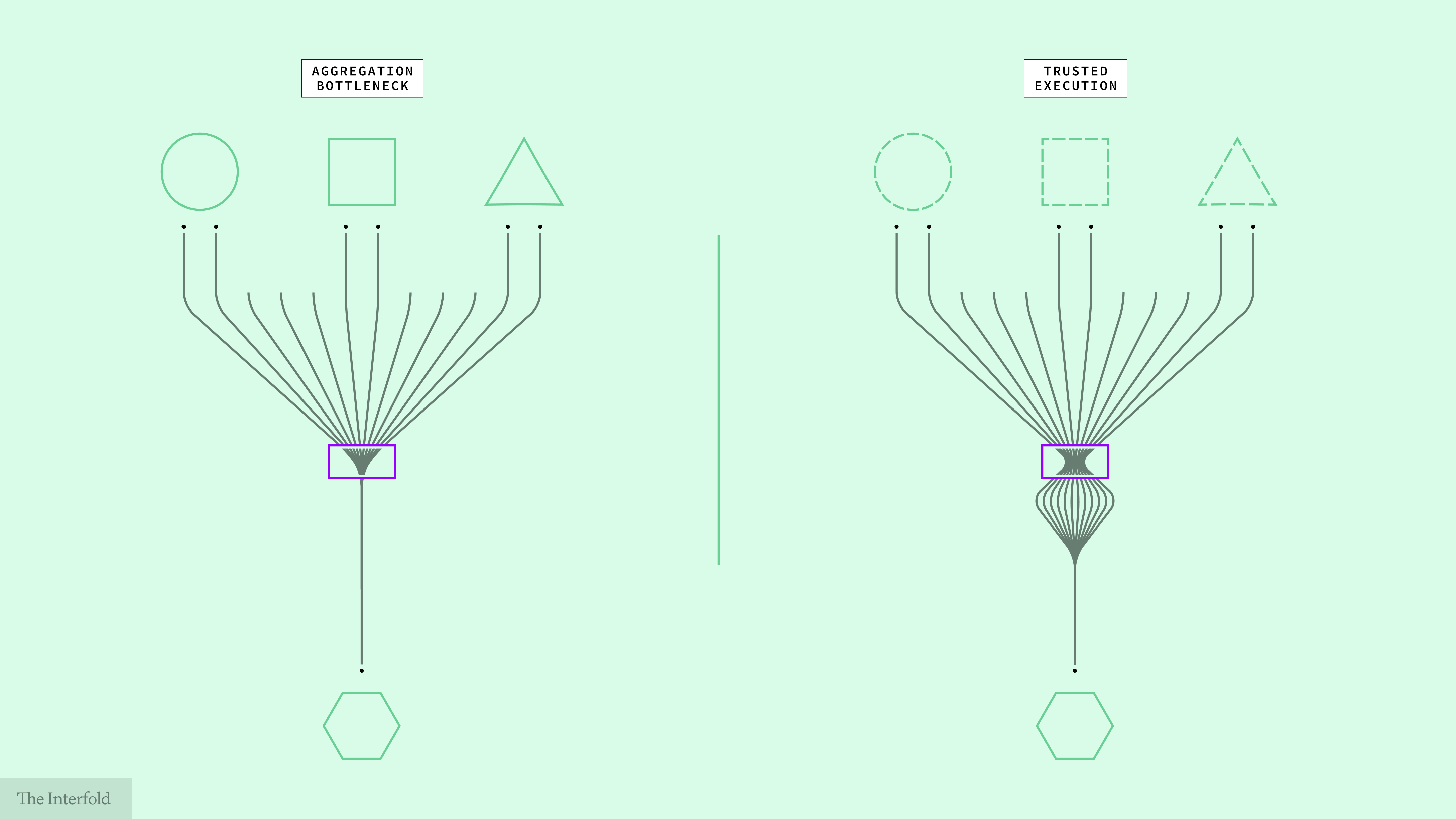
And where execution authority concentrates, power concentrates.
What confidential coordination changes
Confidential coordination is not privacy as concealment.
It is privacy as a condition for coordination.
A secret ballot is not useful because votes stay hidden forever.
It is useful because private choices become a legitimate public result.
A sealed-bid auction is not valuable because bids disappear.
It is valuable because private bids determine a winner without exposing the field during execution.
The pattern is simple:
The result is shared.
The inputs remain hidden.
Trusted systems concentrate execution and release. Confidential coordination distributes execution, verification, and release across a network.
Where The Interfold fits
The Interfold is built for this layer.
It is a distributed network for confidential coordination.
Encrypted inputs from multiple parties enter bounded E3s: Encrypted Execution Environments instantiated for specific computations.
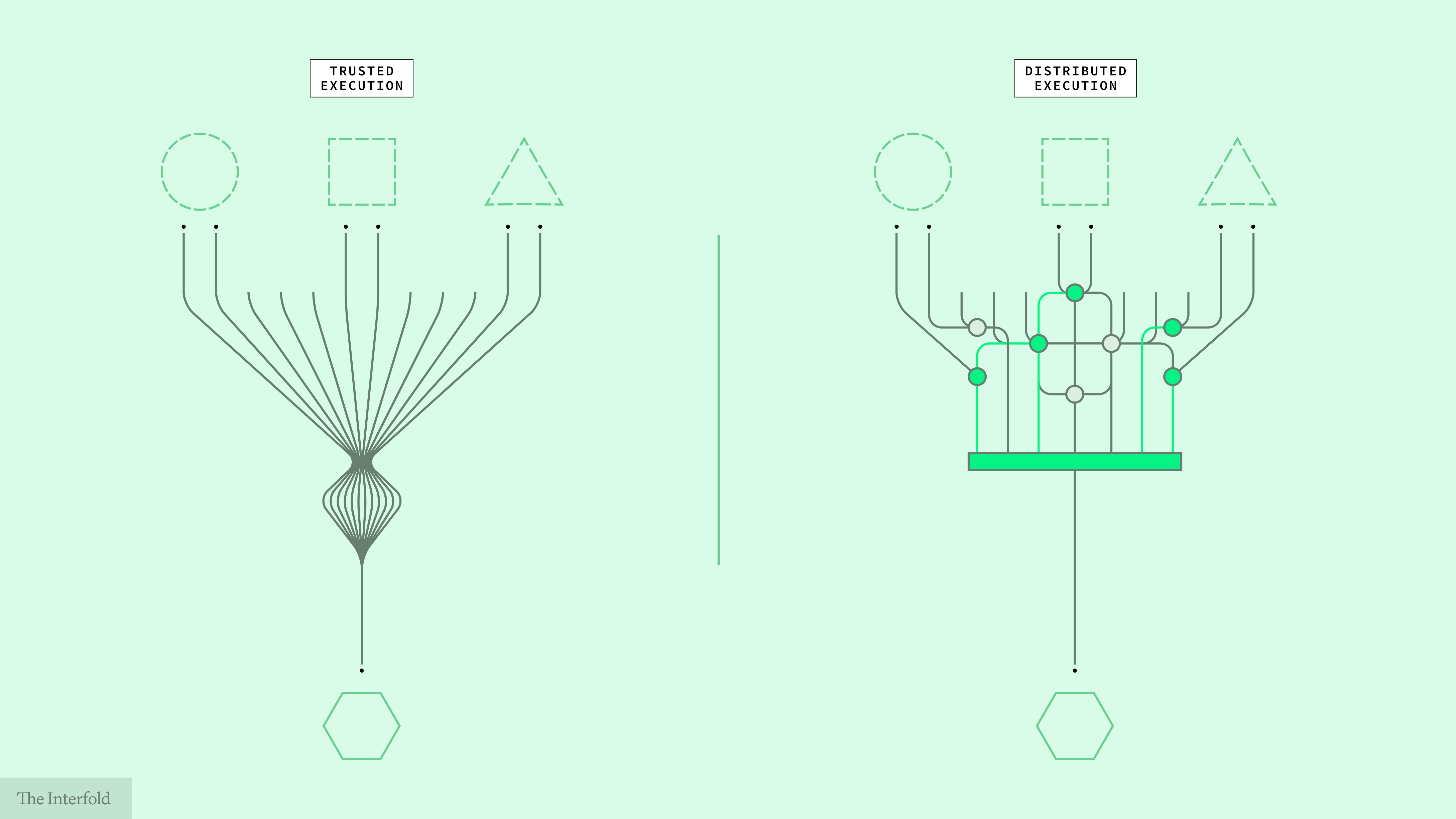
Within an E3, defined program logic runs over private inputs. The outcome can be verified, and release is governed by distributed threshold authority rather than one operator’s discretion.
Many parties.
One result.
No single point of execution control.
The next coordination layer
The internet redistributed communication.
Blockchains redistributed settlement.
Confidential coordination distributes execution authority for multiparty systems.
Not who can publish.
Not who can settle.
But who controls the process by which private inputs become shared reality?
That is the layer The Interfold is built to distribute.
Go deeper
- Why privacy needs to extend into execution
- Why execution can’t remain centralized
- How execution can be distributed
- What this makes possible
Or browse the full series on confidential coordination: