
Toward Network Alpha
The Coordination Trilemma has long forced systems to trade between confidentiality, aggregation, and verifiability. Network Alpha brings a new approach into operation with E3s and a distributed network of ciphernodes.
A growing share of the world’s coordination now happens through computation. Companies, states, institutions, individuals, and organizations of all shapes and sizes benefit from combining their data to produce novel insights.
But doing so often comes at the cost of privacy, security, and sovereignty over an entity’s data.
Independent parties increasingly need to combine sensitive information without revealing their inputs to one another or to a third party: Auctions need bids to clear. Votes need to be counted. Researchers need to analyze data held across several institutions. In each case, private inputs have to produce a shared result.
This is where coordination becomes difficult.
Whether it is an auctioneer, election administrator, data processor, or hardware operator, someone usually occupies a trusted position in the process. They receive the inputs, manage the keys, run the calculation, or certify the result.
The Interfold offers another approach with confidential coordination: private inputs, verifiable outputs, and no reliance on a single trusted operator or trusted hardware.
As the Interfold moves toward Network Alpha, that approach is moving from protocol design into network operation.
The Coordination Trilemma
Any system combining inputs from multiple independent parties has to address three properties:
- Confidentiality: Sensitive inputs and intermediate states remain private.
- Aggregation: Inputs can be combined into a shared result.
- Verifiability: The result can be independently checked against the rules of the process.
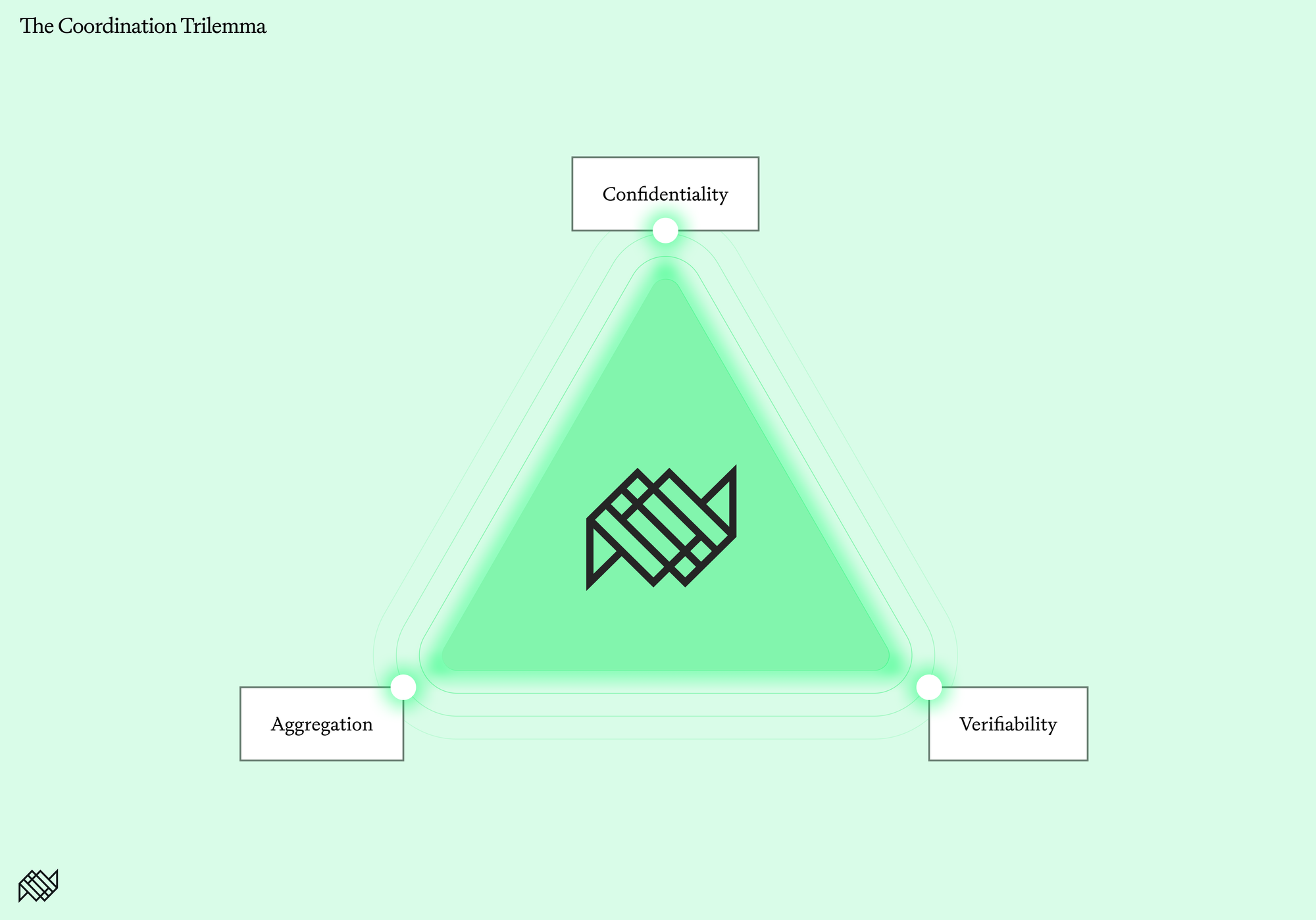
Together, these properties form the Coordination Trilemma. Historically, systems have struggled to provide all three within the same process without concentrating trust somewhere along the way:
- A private institution can preserve confidentiality while aggregating inputs, but participants must rely on it to calculate and report the result correctly.
- A transparent system makes aggregation easier to inspect, but may expose the inputs, intermediate information, or patterns participants intended to keep private.
- Cryptographic systems can protect information and prove important claims about a computation, but applying those guarantees across private state held by multiple parties has historically forced a compromise between confidentiality and the system’s ability to aggregate that information.
For decades, trusted institutions absorbed these constraints. They counted, cleared, calculated, and certified on behalf of everyone involved.
That arrangement followed from the available mechanics of computation. Information could be protected while stored or transmitted, but using it across multiple parties usually meant handing the process to a trusted counter, administrator, or controlled environment.
As a result, the systems that most needed privacy were often the ones most dependent on concentrated trust.
When Privacy Has to Produce a Result
A secret ballot makes the tension easy to see.
A vote must remain private, but an election still needs a tally. The result must be credible to people who cannot inspect the individual ballots.
Traditional elections assign this responsibility to counters, administrators, and controlled systems. Digital voting can make the tally easier to inspect, but public ballots create other vulnerabilities. A voter who can prove how they voted may also be bribed, coerced, or pressured to provide that proof.
The same constraint appears in markets. Bidders need a credible auction result without exposing their valuations or strategies. It appears in research when hospitals want to collaborate without pooling patient records. It appears wherever the value of a result depends on information that participants cannot safely disclose.
Privacy becomes most difficult when private information has to participate in a shared process.
How E3s Work
Encrypted Execution Environments, or E3s, provide the Interfold’s structure for these processes.
An E3 is ephemeral by design. It is created for a specific computation and closes when that computation is complete.
Within an E3:
- Participants encrypt their inputs before submitting them.
- An E3 program defines how those inputs will be combined.
- A committee of ciphernodes collectively creates the shared encryption key.
- The computation runs over the encrypted inputs.
- A defined threshold of ciphernodes participates in decryption.
- The resulting output and the process that produced it can be verified end to end.
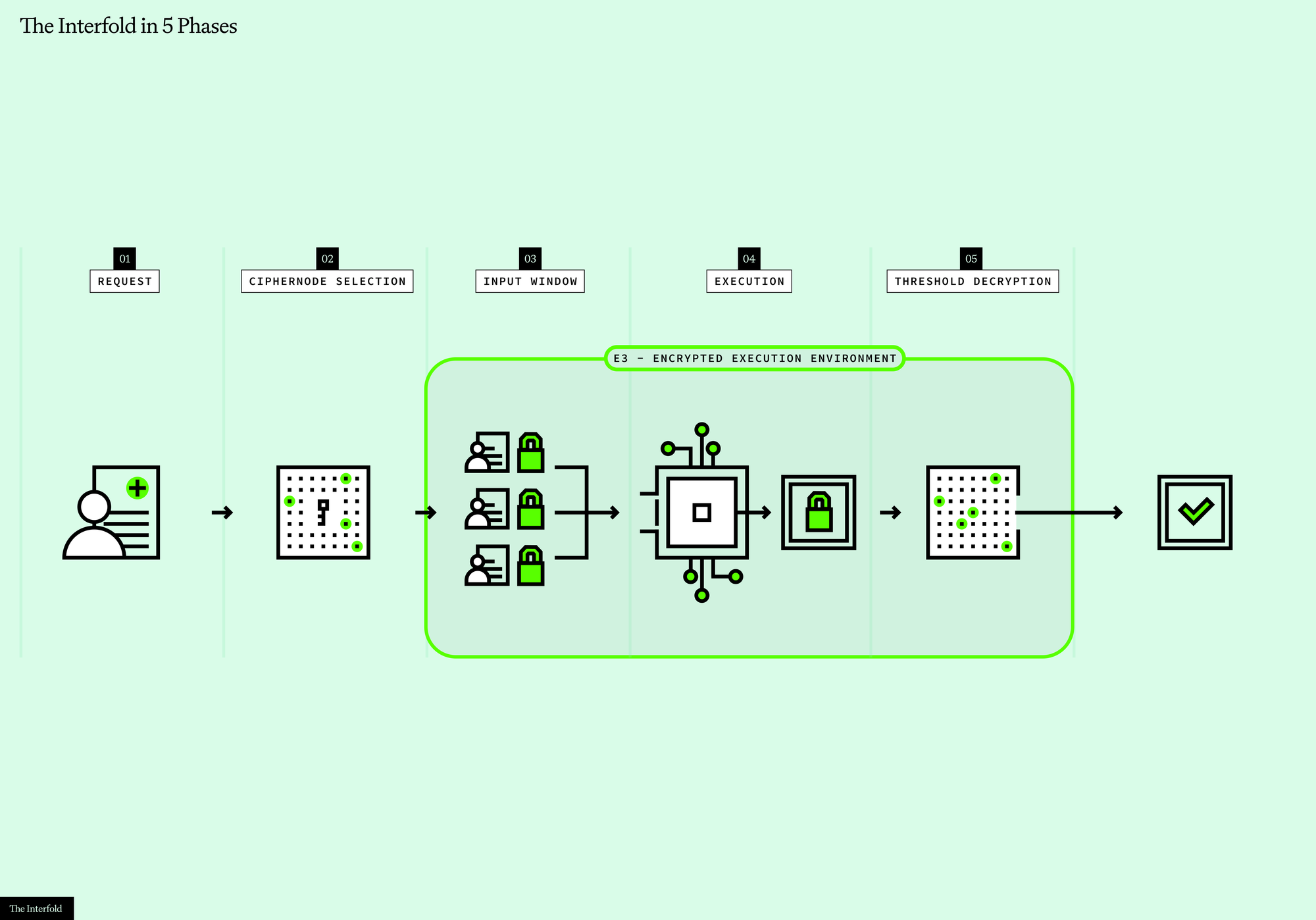
The result, proofs, and relevant onchain events remain available after the E3 closes. The computation-specific key material does not persist as an ongoing point of access, and no individual ciphernode holds the complete private key or decrypts the result alone.
This gives each part of the Coordination Trilemma a place in the same process.
Confidentiality protects inputs and intermediate states. Aggregation occurs through the E3 program. Verifiability establishes that the defined computation produced the result.
Keys Without a Dealer
Encrypted computation depends on how its keys are created and controlled.
Many comparable systems place sensitive key operations inside a Trusted Execution Environment, or TEE. The TEE acts as a protected dealer. This can simplify coordination, but the process depends on trusted hardware, its manufacturer, and the party operating the environment.
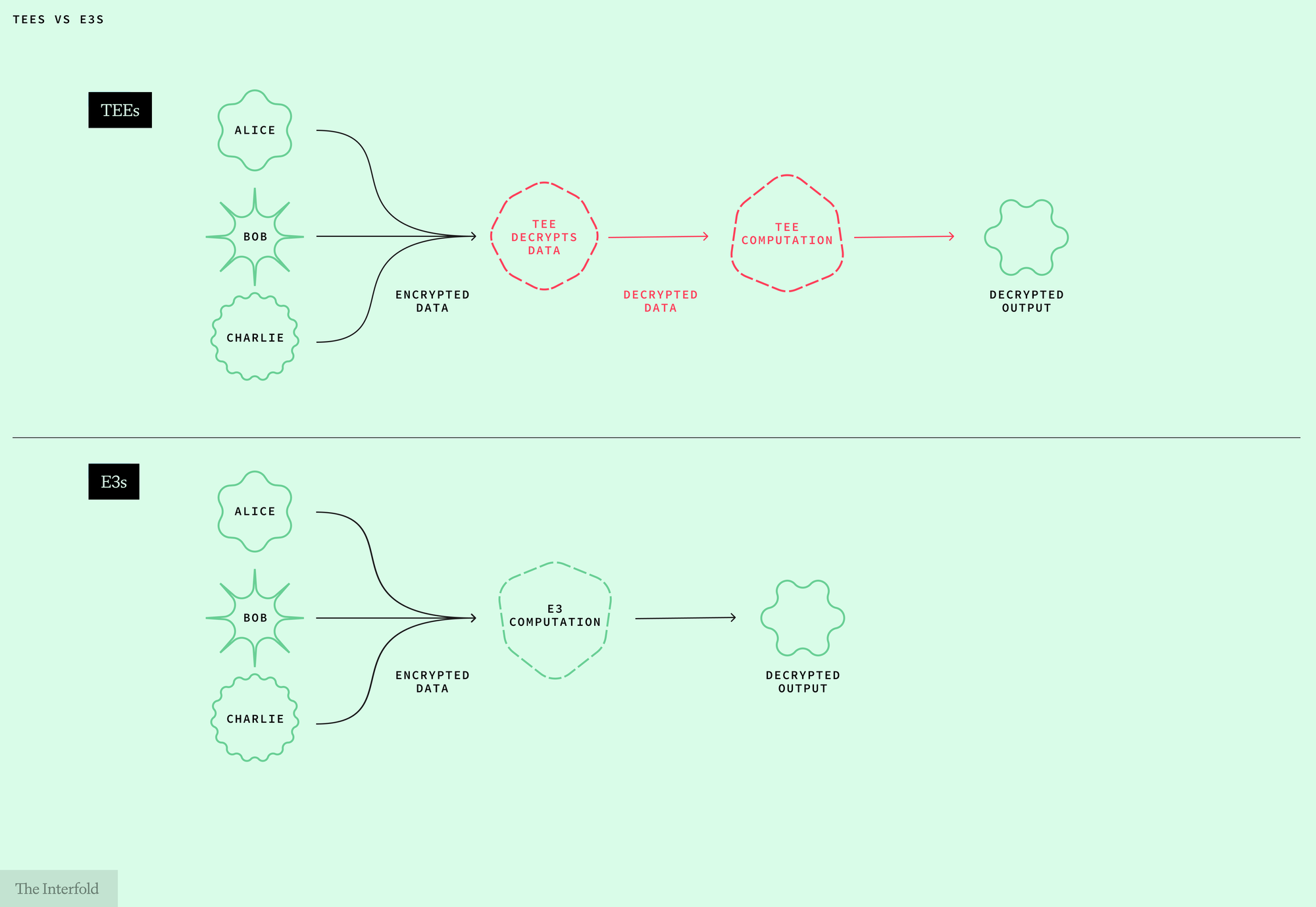
The Interfold distributes this work across ciphernodes.
Its central technical proof point for Network Alpha is publicly verifiable distributed key generation and threshold decryption for a homomorphic encryption scheme.
During distributed key generation, a committee selected by the protocol creates a shared encryption key without any participant learning the complete secret. At the end of the computation, enough committee members collaborate to decrypt the result.
Both processes can be inspected as part of the E3 lifecycle. Sensitive key operations do not disappear inside a hardware enclave or depend on a dealer whose actions remain hidden from the wider network.
Confidential computation begins with the creation of the key protecting the inputs. Making the key ceremony publicly verifiable removes a hidden trust assumption before the first encrypted input is submitted.
Approaching Network Alpha
Network Alpha will bring the complete production E3 lifecycle onto mainnet. Anyone will be able to initiate an E3, and operators who meet the network requirements, including bonding FOLD, will be able to register as ciphernodes for committee duties.
From distributed key generation through encrypted computation and threshold decryption, the process will be publicly verifiable. The Interfold dashboard is expected to point to the mainnet deployment, providing a view into E3 activity and network statistics.
The Interfold’s own governance will be one of the first uses of the network. Through its receipt-free voting integration with Aragon, individual votes can remain private while the final tally remains verifiable.
Network Alpha will make this process visible on mainnet and open the next phase of participation for builders, integration partners, and ciphernode operators.
In the weeks ahead, we will share more about the production bonding and registration path, the first E3s, and the applications entering the network.

Participate in the Interfold network
A distributed network for confidential coordination.
Build on Interfold: Create applications that coordinate across private inputs and produce verifiable outcomes.
Interested in running a ciphernode?
Review the current operator requirements and prepare for participation.
Follow the Interfold: Track the network as it evolves, with updates, early use cases, and the emergence of a distributed system in practice.